
The further in you go, the bigger it gets

| Volume & Issue | MMXXVI • 38 | Offices |
Pawpaw, Grape, Yarrow, Oregano, Saw, Crab, Literature |
| Celebrations |
Sat. International Talk Like a Pirate Day |
Heavens |
First Quarter ♍︎ Virgo |
The eighteenth of September, Broken Hearts Manor — I learned the other day that my favorite living author, John Crowley, passed away about a month ago.
Literature is a door to knowledge about the self and the world we find ourselves in. Sometimes that door is an obvious imposing gate, planks bound with iron, a heavy push to open. Sometimes the door is instead a threshold we wander over without ever quite realizing until much later that we have passed into a strange land.
My favorite of Crowley’s writing is his novel Little, Big. It’s a family saga, or a story of city and country, or maybe it’s about fascism, or fairies. You should really just read it yourself, because I find it inspires a wonder within my thoughts that leaves it largely indescribable. I return to it periodically (most recently in the form of the breathtakingly crafted 25th-anniversary-cum-40th-anniversary edition), and each time I discover something new, a corner I’ve turned around or a threshold crossed.
I corresponded with the author once, sending him a question about the design of a garden he described and whether it had real-life inspiration. He responded with grace and kindness and I cherish that he took the time—by all accounts, that was his manner. He spent decades as a lecturer at Yale and is remembered so by his students, and outward ripples of other friends and admirers.
John Crowley has, undoubtedly, gone one further step within. The passing is as baffling and mysterious as the presence. We’ll know him now through his words that remain.
The hinge of the year
There’s been an autumnal chill in the evenings and mornings this week, the kind of weather in which you both throw open the windows for the fresh air and simultaneously wrap your fingers around a steaming coffee cup for warmth. The equinox approaches next week (September 22, Tuesday) marking the balancing point between summer and fall. Moreover, this will forever be for me the week of return to school—though the schoolchildren have been back for several weeks already in most places, I attended a college quaintly organized by quarters, and the fall term starts in the latter half of September.
The harvest will begin to slow soon, though as of this week shows no signs just yet. Tomatoes coming in as fast or faster than I can deal with them, and everything else as well. This past week I’ve canned tomatillo salsa and tomato marmalade, made tomato confit and okra refrigerator pickles, and frozen the last of the rhubarb.
Putting away safely
If you’re also feeling industrious about preserving and putting away the harvest for over the winter, please do so safely, especially when it comes to canning in jars to store food at room temperature. Botulism is a real risk, and although it’s rare, the consequences are steep. Because of that, use scientifically tested recipes from sources such as your local university agricultural extension, the National Center for Home Food Preservation, or Healthy Canning, or grab the Ball Blue Book you can find in the grocery store next to the mason jars. You may also find the sub-Reddit r/canning to be very helpful for advice, questions, and recipe recommendations.

 Learn more about Healthy Canning →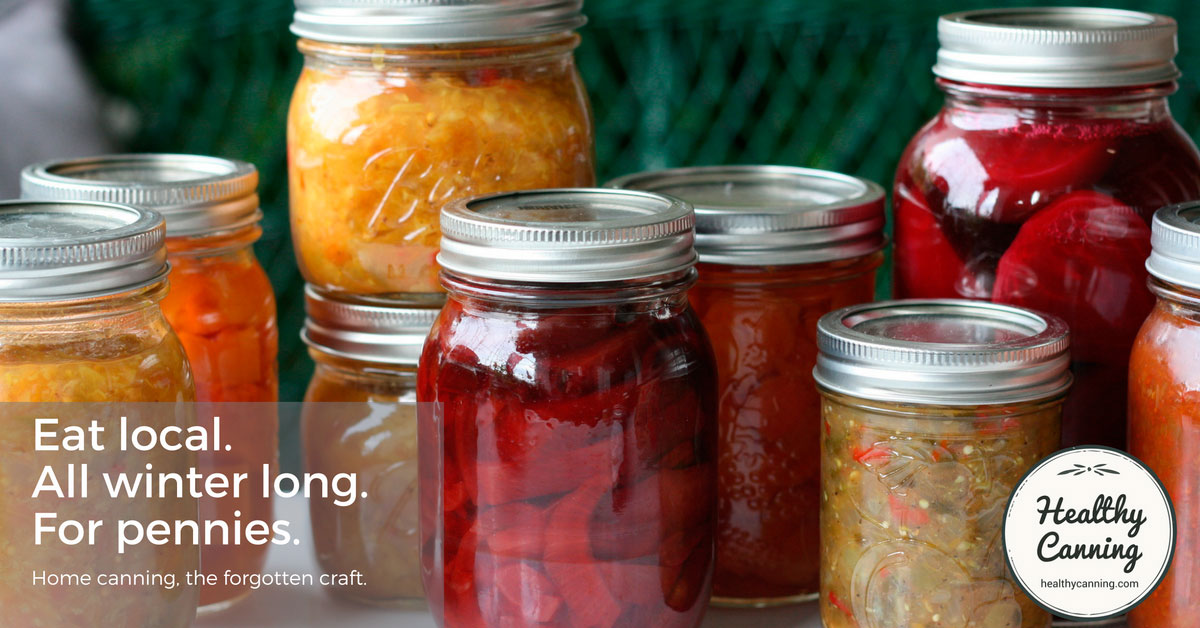
I've been canning for many years, since I was probably five or six cranking the strainer to make tomato juice in the basement. We always had an old secondhand stove in the basement for canning (no air conditioning in those days). But every time I am going to do some canning, I review the steps to make sure I don’t forget anything—and keep in mind, methods and tools have changed over the years. Do you know you don’t need to heat the lids any more? And you don’t need to sterilize jars before filling if they are going to be processed 10 minutes or longer? (If you have an old Ball Blue Book or other canning cookbook, keep it as a treasured keepsake, but get a new one. If it’s from before 2014, it doesn’t have the most updated methods and advice.)
These recipes, from reliable sources, have been tested to ensure the safety of your family and friends who consume your food. The internet is rife with recipes from everyone and their mother that have not been tested in these ways (and even some who proudly wear the label “cowboy canner” openly flouting such tested guidelines). And I know how tempting it can be to think “Grandma always did it this way and no one got sick” but it’s just not worth the risk. Canning is science, and it’s about temperature and density and other factors that make the food safe from contamination at room teperatures. Compare any canning recipe you find on the internet to a safe, lab-tested version to make sure you’re staying safe.
On the other hand—don’t be scared of canning. It’s really not hard, and if you follow the instructions and methods in a tested recipe, it’s an entirely safe way to preserve much of your garden harvest without requiring refrigerator or freezer space. If you’re just beginning, I recommend boiling-water canning whole or crushed tomatoes as a first-time effort; it’s both straightforward and useful.